Mostrando entradas con la etiqueta Texts Analisys. Mostrar todas las entradas

miércoles, 6 de febrero de 2019

THE CORONATION OF CHARLEMAGNE


The two texts were are going to analyze are recounts, that tell us about the coronation of Charlemagne. Both are primary sources, because they are directly traduced from the original one; and they're also public, they were made to be read by any person.There are different authors, the first is a writer from the Pope's orbit and the second is a member of Charlemagne's court, that provide different perspectives about the same event.

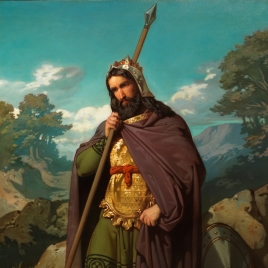
Resultado de imagen de charlemagne

The coronation of Charlemagne, that took place in the year 800, is the main theme of both texts. It was celebrated in Rome, at the Basilica of Saint Peter the Apostle, on December 25th. According to the texts, Charlemagne was crowned as emperor by Pope Leo in a religious celebration, in front of all the people of Rome. Charlemagne was a Frankish king, and later emperor, who ruled much of Western Europe from 768 to 814. During his reign, he sought to unite all the Germanic peoples into one kingdom and to convert them to Christianity


A further analysis of the texts shows that they have some similarities. Both texts coincide in the place and the date of the celebration: it was at St. Peter's basilica,in Rome, on December 25th, in the year 800. Another thing in common is the praise of the people of Rome that took part in the coronation. Basing on the date of the celebration, the day of Lord's birth,  we can come to the conclusion that Charlemagne chose  this day with political, religious and symbolic purposes. He sought to compare himself with Jesus and he is also competing with the Pope for the leadership of the Christianity.

That "competition" between the Pope and Charlemagne, is clearly founded in the two different perspectives of the texts. The first text, written from the Pope's orbit, gives importance to the Pope and shows Charlemagne as his subject, (lines 3, 10, 12- text 1).
On the other hand, the second text, written by a member of Charlemagne's court, explicitly says that Charlemagne received the crowned standing up and that the Pope kneeled down to "adored" him, (line 5- text 2).

As a conclusion we can relate the texts with Charlemagne's biography, especially with the episode of the war against the Lombards. He went to Rome to fight against the Lombards, as his father Pepin the Short did, and to help Pope Leo III. He was considered the defender of Christianity, and meanwhile he was in Rome, he was crowned by the Pope as the new Holy Roman Emperor. With regard to Charlemagne's objectives, we can affirm that he fought to unite all the Germanic peoples into one kingdom, with one ruler and one religion, Christianity. Based on these dates we can finally argue that Charlemagne sought to unite his kingdom in the form of Ancient Roman Empire, trying to recover its grandeur.

Resultado de imagen de coronación de carlomagno


miércoles, 14 de noviembre de 2018

LEY DE MATRIMONIOS MIXTOS DE LEOVIGILDO


La ley de matrimonios mixtos de Leovigildo es un texto legislativo, de carácter público. Es una fuente primaria, posiblemente escrita por un funcionario de la corte de Leovigildo.

El texto fue redactado en el siglo VI, durante el reinado de Leovigildo(568-586). Este rey fue el artífice de la unificación del Reino Visigodo, gracias a sus campañas contra los suevos y los bizantinos; y además creó el Código Legislativo de Leovigildo, en el cuál se integra esta ley de matrimonios mixtos, y que, posteriormente, fue incluido en el Liber Iudiciorum, creado por el rey Recesvinto(s.VII).

El texto está dividido en tres partes claras, indicadas por cada uno de los tres párrafos que lo forman:

La primera parte está formada por las líneas 1 y 2, y es una introducción a la ley.
La segunda parte va desde la línea 3 hasta la 6, y constituye una especie de justificación de la ley, promulgada por el rey Leovigildo. En esta parte se elogia al rey ("príncipe") por buscar "beneficios para su pueblo". También nos habla de la existencia de una antigua ley (línea 5),que prohibía los matrimonios entre hispanorromanos y visigodos, probablemente de época de Antanagildo, el rey previo a Leovigildo. Además, en este fragmento hace una referencia curiosa a la libertad de las personas desde su nacimiento, "ingénita libertad", (línea 4).
La tercera parte va desde la línea 7 hasta la 12, y constituye el desarrollo de la propia ley. A partir de la publicación de esta orden, estarán permitidos los matrimonios entre hispanorromanos y visigodos, siempre y cuándo se den una serie de condiciones: debe haber una "previa petición de mano" (línea 9), debe ser un matrimonio entre dos personas libres (líneas 10,11), la pareja debe informar a la familia de su decisión (línea 11) y debe contar con el permiso paterno, "consenso del linaje" (línea 12).

Esta ley de matrimonios mixtos de Leovigildo (568-586), forma parte de todo un conjunto de medidas adoptadas por lo reyes visigodos para favorecer la integración jurídica, social y religiosa de los dos pueblos, hispamorromanos y visigodos, durante el periodo en el que este pueblo de origen germánico consolidó su Reino en Hispania. La ley de matrimonios mixtos de Leovigildo favoreció la integración social entre los dos pueblos, al eliminar una ley que prohibía los matrimonios entre ellos. Por otro lado, tanto Atanagildo, estableciendo la capitakl del reino en Toledo en el año 567, como Leovigildo y Suintila, con sus campañas contra suevos y bizantinos, lograron la unidad territorial del reino. Finalmente, Recaredo favoreció la unión religiosa al abandonar el arrianismo y adoptar la doctrina católica, que era mayoritaria entre el pueblo hisopanorromano; y Recesvintoconsiguióp la unidad jurídica recopilando todas las leyes del reino en un único cuerpo legislativo llamado Liber Iudiciorum. Para entender estas medidas es necesario tener en cuenta que los visigodos constituían una minoría (150 000) frente a la mayoría hispanorromana (6 millones).
                  

 LEY DE MATRIMONIOS MIXTOS DE LEOVIGILDO